pluto.planets.im
A dwarf planet, clearly labelled as one, with a heart of ice.
The International Astronomical Union reclassified Pluto as a dwarf planet in 2006. NASA Science and the IAU’s own resolution text both say so, in wording this site keeps distinct. New Horizons, in 2015, then showed a world with mountains, glaciers, a blue haze, and a bright heart.
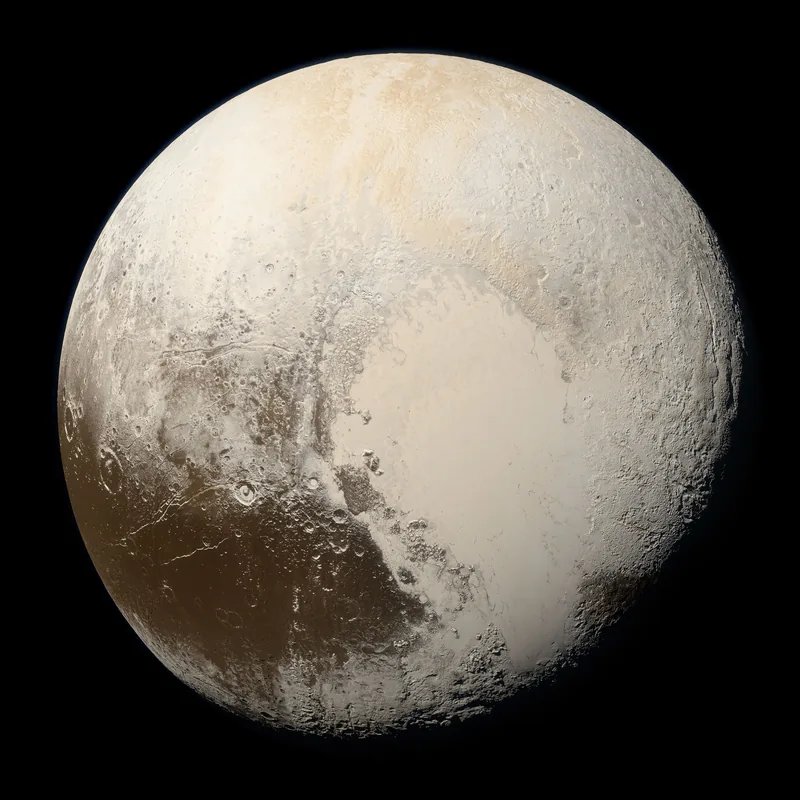
A dwarf planet, with a heart
This site is about Pluto, and it labels Pluto as a dwarf planet throughout. NASA Science is plain: discovered in 1930, Pluto was long considered our solar system’s ninth planet, but after the discovery of similar worlds deeper in the Kuiper Belt, it was reclassified as a dwarf planet in 2006 by the International Astronomical Union. [source] The IAU’s own 24 August 2006 announcement is just as direct. Resolution 5A sets out three categories of bodies orbiting the Sun, except satellites: planets, dwarf planets, and small Solar-System bodies. Resolution 6A then says: “Pluto is a ‘dwarf planet’ by the above definition and is recognized as the prototype of a new category of trans-Neptunian objects.” [source]
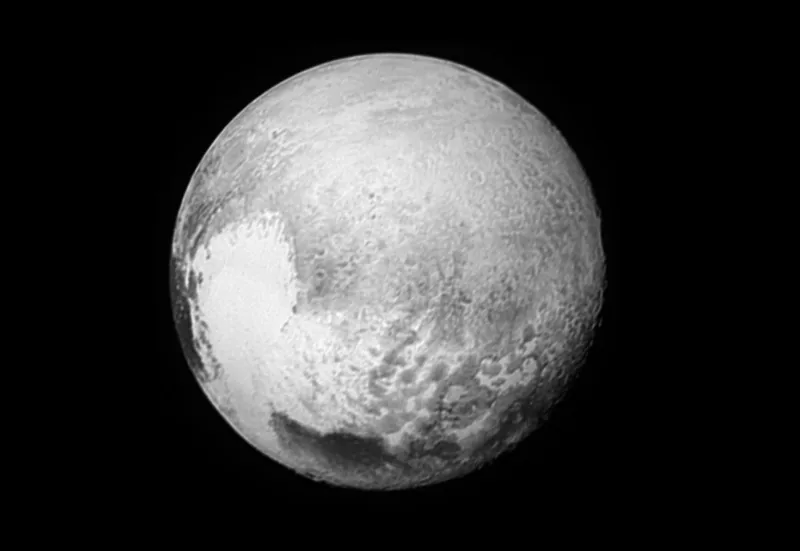
NASA Science’s facts page introduces a heart-shaped image taken on 13 July 2015, when New Horizons was 476,000 miles (768,000 kilometres) from the surface. [source] The still above is the official 13 July catalog frame of that region, “Mapping Pluto’s ‘Broken Heart.’” The only spacecraft to explore Pluto up close, the same facts page says, was NASA’s New Horizons, which flew by the dwarf planet and its moons in 2015. [source]
It is a complicated little world. NASA Science describes mountains, valleys, plains, craters and glaciers, in the distant Kuiper Belt, with a thin atmosphere of nitrogen, methane and carbon monoxide, and five known moons, the largest of which is Charon — about half the size of Pluto itself, often referred to as a “double planet.” [source] A later official Charon page calls the pair a “double dwarf planet system.” [source] Those two official phrases are kept side by side on the Charon desk.
Why a dwarf planet?
The IAU’s official 2006 wording, NASA Science’s paraphrase, and three official widths that are not quite the same number.
A heart of ice
Sputnik Planitia, water-ice mountains, nitrogen glaciers, and a 2026 analysis of possible liquid nitrogen at the surface.
A moon that never rises
Charon hovers over the same spot. Five moons in all, two official distances, and a locked dance.
An 11-year-old named it
Clyde Tombaugh in 1930, Venetia Burney over breakfast, and a vote in Prague in 2006.
Enjoyed a clearly labelled dwarf planet, and a heart of nitrogen ice?
No pop-ups. No intrusive advertising. Just interesting stuff. A little support helps the next planets.im site get built.