Moons
A moon that never rises, and a dance that never quite uses one official number.
Charon hovers over the same spot on Pluto. The fact sheet, the facts page and the Charon page then offer distances and diameters that are close, official, and not identical. Pluto remains a dwarf planet on this page, even where an official sentence still says “the planet it orbits.”
Pluto has five known moons on both official pages: Charon, Nix, Hydra, Kerberos and Styx. [source] [source] NASA Science says the system might have formed by a collision between Pluto and another similar-sized body early in the solar system’s history. Charon is about half the size of Pluto, “making it the largest satellite relative to the planet it orbits in our solar system.” [source] That official sentence still uses the word planet for the body being orbited. It is quoted as written, on a page that otherwise labels Pluto a dwarf planet.
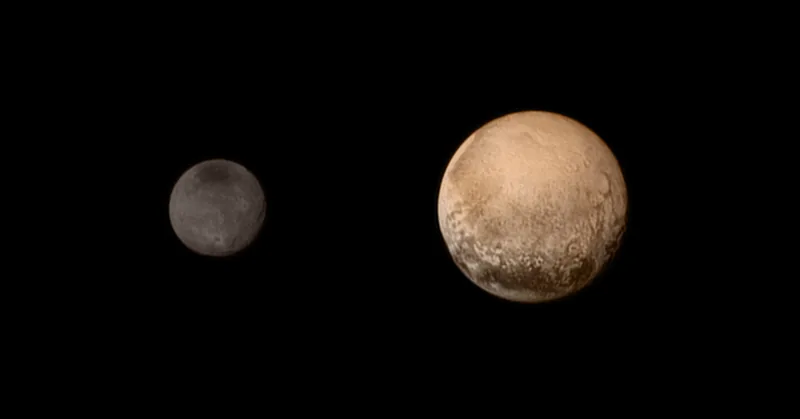
Two official distances sit side by side. The fact sheet gives Charon’s mean distance from Pluto as 19,596 km, with a sidereal orbit and rotation of 6.3872 days and an equatorial radius of 606 km. [source] NASA Science’s facts page says Charon orbits at just 12,200 miles (19,640 kilometres) — “for comparison, our Moon is 20 times farther away from Earth” — and that the orbit takes 153 hours, the same time Pluto takes to complete one rotation, so Charon neither rises nor sets, but hovers over the same spot. The same side of Charon always faces Pluto: tidal locking. [source] The official Charon page says the same surfaces of Charon and Pluto always face each other, a mutual tidal locking, and that Charon is 754 miles (1,214 kilometres) across, orbiting every 6.4 Earth days, while Pluto is about 1,400 miles wide. [source] A family-portrait file on this site gives Charon a diameter of 751 miles. Those official figures are close. They are not silently merged.
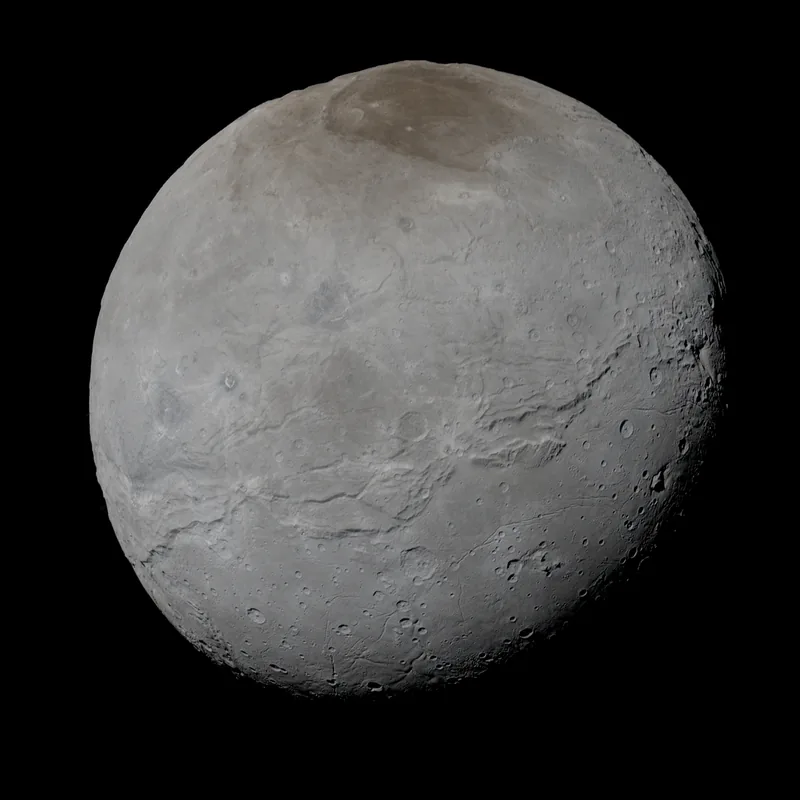
NASA Science’s facts page often refers to Pluto and Charon as a “double planet.” [source] The Charon page says that because Charon is so big compared with Pluto, “the two are sometimes referred to as a double dwarf planet system.” [source] Both phrases are official, and both stay visible.
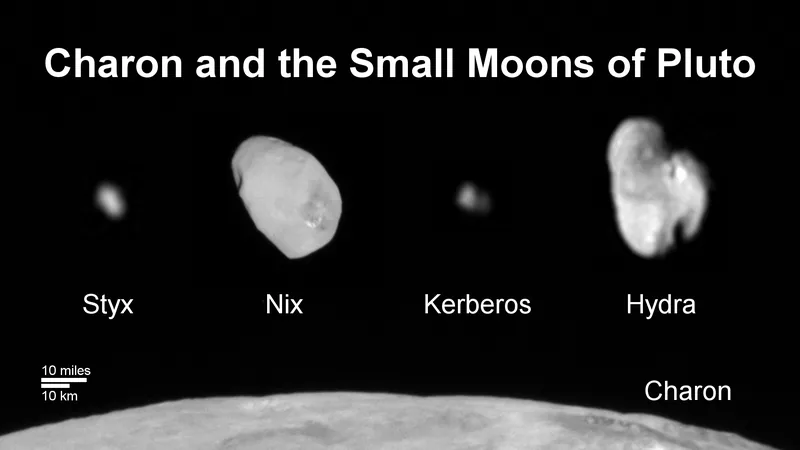
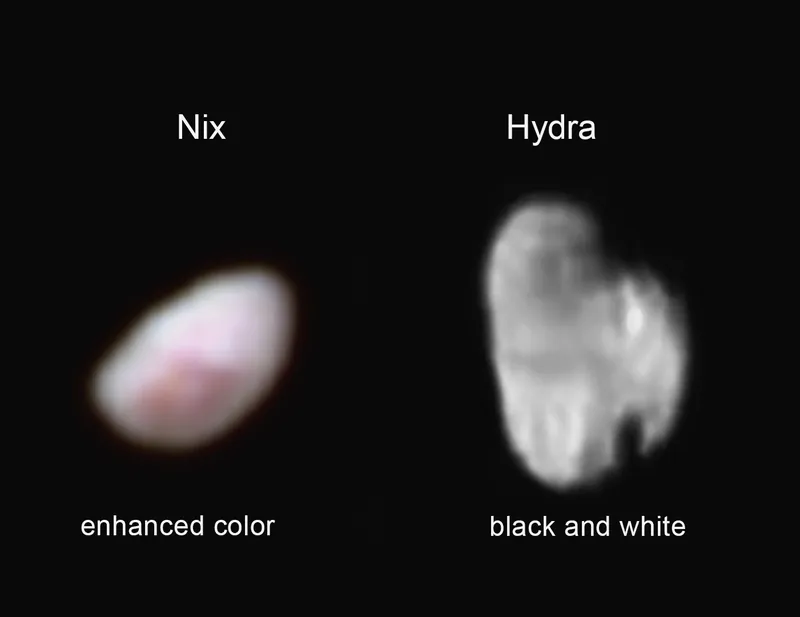
The other four moons, NASA Science says, are much smaller, less than 100 miles (160 kilometres) wide, irregularly shaped, and — unlike many moons — not tidally locked to Pluto. They all spin and do not keep the same face toward it. [source] Nix, in the enhanced-colour frame above, has a reddish spot that attracted the interest of mission scientists, according to the official caption. The fact sheet gives barycentric distances and sizes for Styx, Nix, Kerberos and Hydra, including Nix at 48.4 × 33.8 × 31.4 km and Hydra at 62.0 × 36.5 × 29.3 km. [source]
Enjoyed a clearly labelled dwarf planet, and a heart of nitrogen ice?
No pop-ups. No intrusive advertising. Just interesting stuff. A little support helps the next planets.im site get built.