Credits
Every photograph on this site
Licences were checked on each source page on 18 November 2026. All twelve stills are public-domain NASA / Johns Hopkins APL / Southwest Research Institute photographs, credited on this page. Enhanced-colour frames, informal 2015 place-names, and later official names are labelled as such.
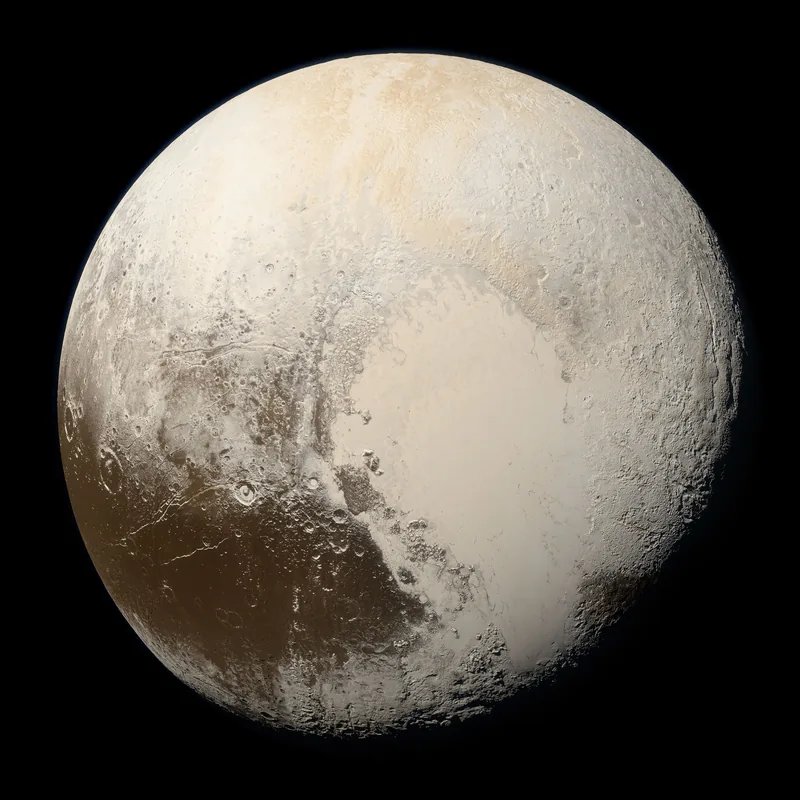
Pluto, taken by New Horizons on 14 July 2015, from 22,025 miles (35,445 kilometres). The official file says the striking features are clearly visible, including the bright expanse of Pluto’s icy, nitrogen-and-methane rich “heart,” Sputnik Planitia, and that the natural-looking colours result from refined calibration of data gathered by the colour Multispectral Visible Imaging Camera (MVIC). True colour, as labelled. Public domain. Photo: NASA / Johns Hopkins University Applied Physics Laboratory / Southwest Research Institute · Public domain · NASA/JHUAPL/SwRI / Wikimedia Commons 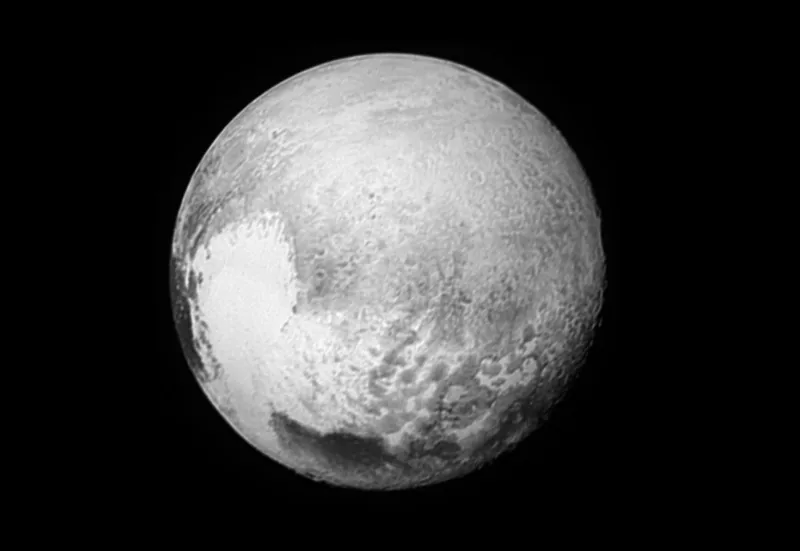
PIA20037, 13 July 2015: “Mapping Pluto’s ‘Broken Heart.’” NASA Science’s facts page, separately, introduces a heart-shaped image taken the same date, when New Horizons was 476,000 miles (768,000 kilometres) from the surface. This catalog still is the 13 July mapping frame of that region. Public domain. Photo: NASA / Johns Hopkins University Applied Physics Laboratory / Southwest Research Institute · Public domain · NASA/JHUAPL/SwRI / Wikimedia Commons 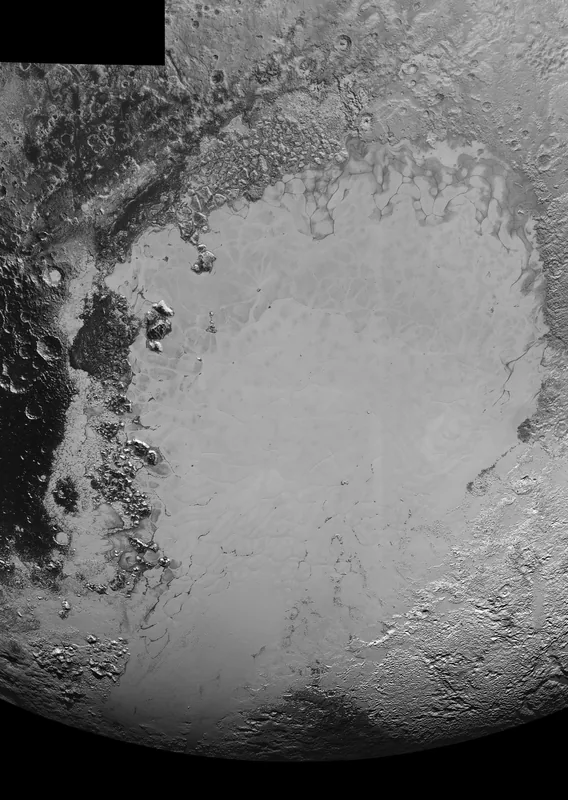
A mosaic of high-resolution LORRI images, returned in early September 2015, dominated by the informally named icy plain Sputnik Planum — the file’s own wording. The region is now officially Sputnik Planitia; the 2015 caption is not silently rewritten. The smallest visible features are 0.5 miles (0.8 kilometres). Public domain. Photo: NASA / Johns Hopkins University Applied Physics Laboratory / Southwest Research Institute · Public domain · NASA/JHUAPL/SwRI / Wikimedia Commons 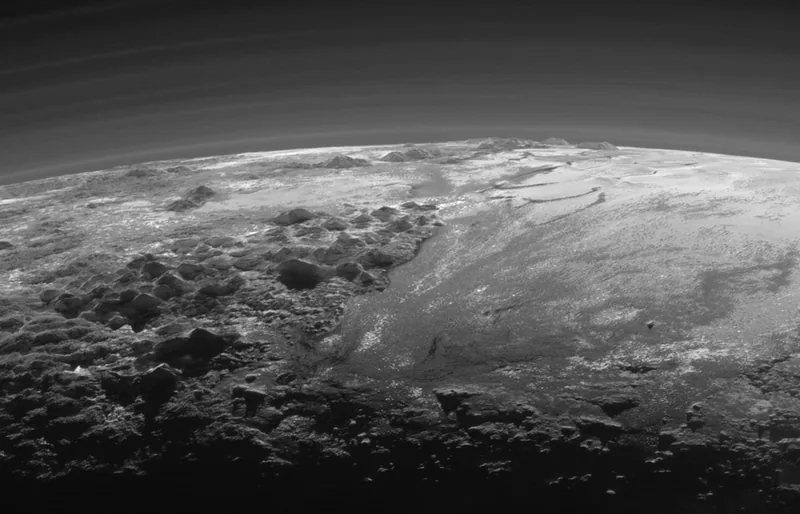
PIA19947, “Closer Look: Majestic Mountains and Frozen Plains.” Just 15 minutes after closest approach on 14 July 2015, New Horizons looked back toward the Sun and captured this backlit view of Norgay and Hillary Montes and the frozen plains. Public domain. Photo: NASA / Johns Hopkins University Applied Physics Laboratory / Southwest Research Institute · Public domain · NASA/JHUAPL/SwRI / Wikimedia Commons 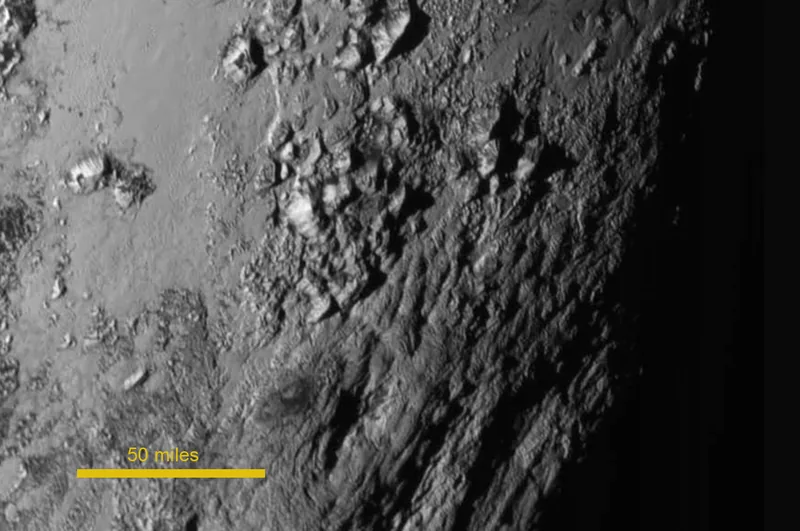
The Icy Mountains of Pluto, an official New Horizons still from the 14 July 2015 encounter, released by JHUAPL. Water-ice mountains stand beside a smooth plain. Public domain. Photo: NASA / JHU APL / SwRI · Public domain · NASA/JHUAPL/SwRI / Wikimedia Commons 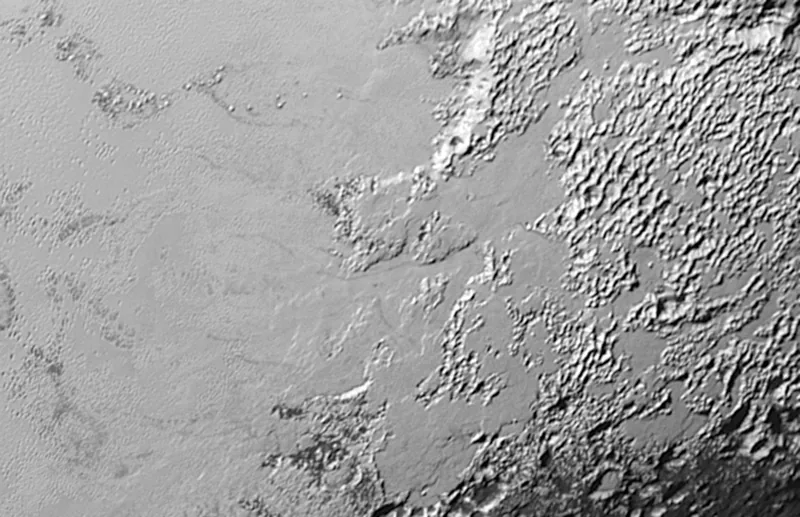
PIA19944, “Valley Glaciers on Pluto.” The official caption says ice (probably frozen nitrogen) that appears to have accumulated on the uplands is draining from Pluto’s mountains onto the informally named Sputnik Planum through valleys 2 to 5 miles (3 to 8 kilometres) wide, in a view 390 miles (630 kilometres) across. Informal 2015 name kept as the file has it. Public domain. Photo: NASA / Johns Hopkins University Applied Physics Laboratory / Southwest Research Institute · Public domain · NASA/JHUAPL/SwRI / Wikimedia Commons 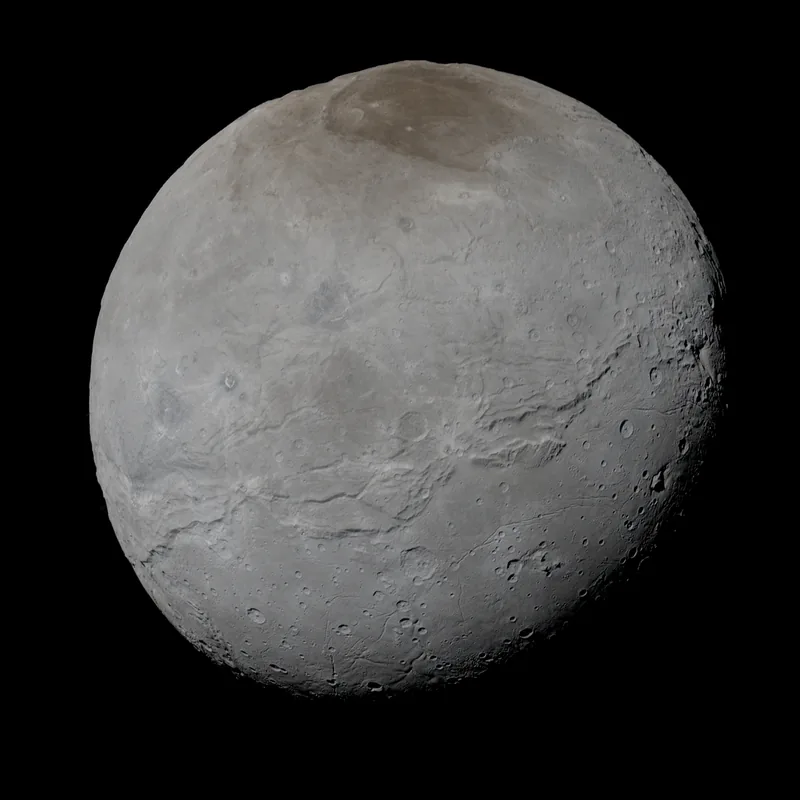
A high-resolution true-colour view of Charon, released to mark the anniversary of New Horizons’ 14 July 2015 flight through the Pluto system. Official file: NASA / JHUAPL / SwRI. Public domain. Photo: NASA / Johns Hopkins University Applied Physics Laboratory / Southwest Research Institute · Public domain · NASA/JHUAPL/SwRI / Wikimedia Commons 
PIA21590, “Blue Rays, New Horizons’ High-Res Farewell to Pluto.” The official caption calls this the highest-resolution colour departure shot of Pluto’s receding crescent, taken when the spacecraft was 120,000 miles (200,000 kilometres) away, shown in approximate true color, from a mosaic of six LORRI frames with colour added from lower-resolution Ralph data. Published 24 March 2017; taken 14 July 2015. Public domain. Photo: NASA / Johns Hopkins University Applied Physics Laboratory / Southwest Research Institute · Public domain · NASA/JHUAPL/SwRI / Wikimedia Commons 
“Pluto’s Blue Sky”: the official caption says Pluto’s haze layer shows its blue colour in this picture from New Horizons’ Ralph/MVIC, and that the high-altitude haze is thought to be similar in nature to that seen at Saturn’s moon Titan, likely involving sunlight-initiated chemical reactions of nitrogen and methane. Public domain. Photo: NASA / JHUAPL / SwRI · Public domain · NASA/JHUAPL/SwRI / Wikimedia Commons 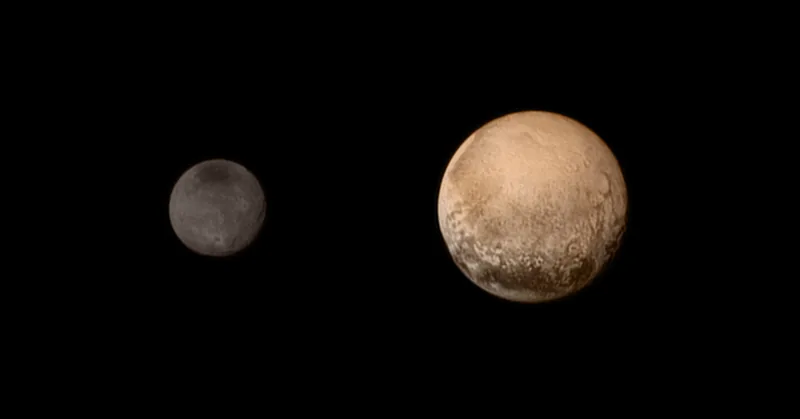
Pluto and Charon on 11 July 2015, from New Horizons’ final approach. The official caption calls it a portrait showing striking colour and brightness contrast, made from high-resolution black-and-white LORRI images colourised with Ralph data collected from the last rotation of Pluto. Public domain. Photo: NASA / JHUAPL / SwRI · Public domain · NASA/JHUAPL/SwRI / Wikimedia Commons 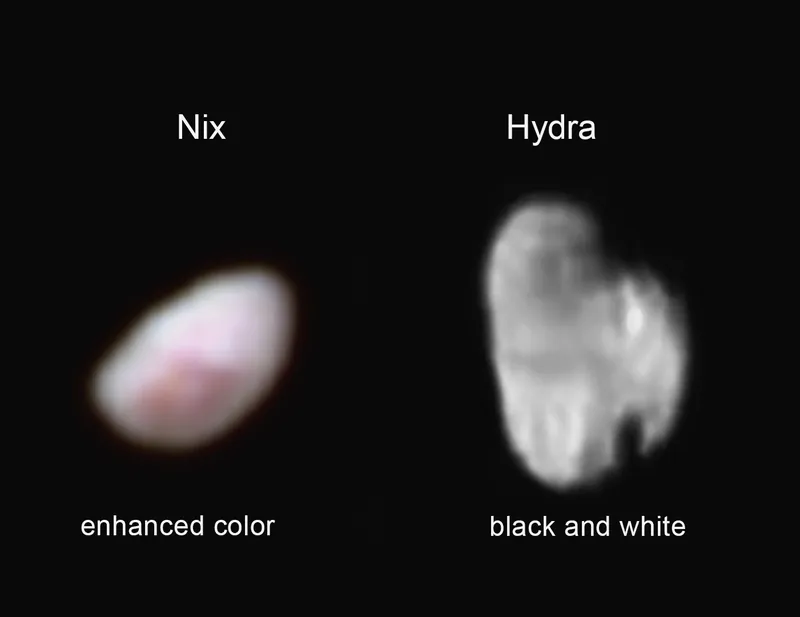
New Horizons images of Nix (left) and Hydra. The official NASA caption says Nix is shown here in enhanced color, and has a reddish spot that attracted the interest of mission scientists. Enhanced colour, as labelled. Public domain. Photo: NASA / JHUAPL / SwRI · Public domain · NASA/JHUAPL/SwRI / Wikimedia Commons 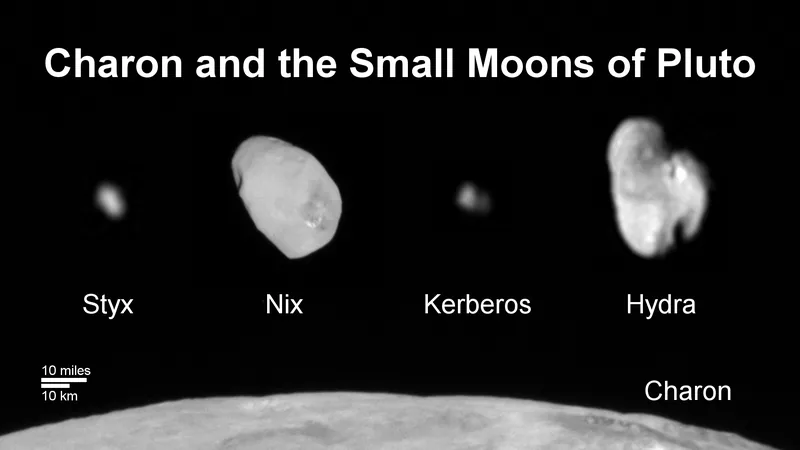
“Family Portrait of Pluto’s Moons”: a composite of Charon and all four small moons, as resolved by LORRI, displayed with a common intensity stretch and spatial scale. The official caption says Charon is by far the largest, with a diameter of 751 miles. NASA Science’s Charon page, separately, gives 754 miles (1,214 kilometres). Both official wordings stay unblended. Public domain. Photo: NASA / JHUAPL / SwRI · Public domain · NASA/JHUAPL/SwRI / Wikimedia Commons
Enjoyed a clearly labelled dwarf planet, and a heart of nitrogen ice?
No pop-ups. No intrusive advertising. Just interesting stuff. A little support helps the next planets.im site get built.