History
Found in 1930, named over breakfast, reclassified in Prague.
The official fact sheet dates the discovery to 18 February 1930. NASA Science tells how an 11-year-old in Oxford suggested the name. The IAU’s 24 August 2006 resolutions then placed Pluto in a new, distinct class: dwarf planets.
The official fact sheet lists the discoverer as Clyde Tombaugh and the date as 18 February 1930. [source] NASA Science adds the naming. Pluto was named by an 11-year-old girl. In 1930, Venetia Burney of Oxford, England, suggested to her grandfather that the new discovery be named for the Roman god of the underworld. He forwarded the name to the Lowell Observatory and it was selected. In an interview with NASA in January 2006, Venetia said she offered the name over breakfast with her mother and grandfather on 14 March 1930, after her grandfather, Falconer Madan, had announced that scientists had discovered the ninth planet. [source]
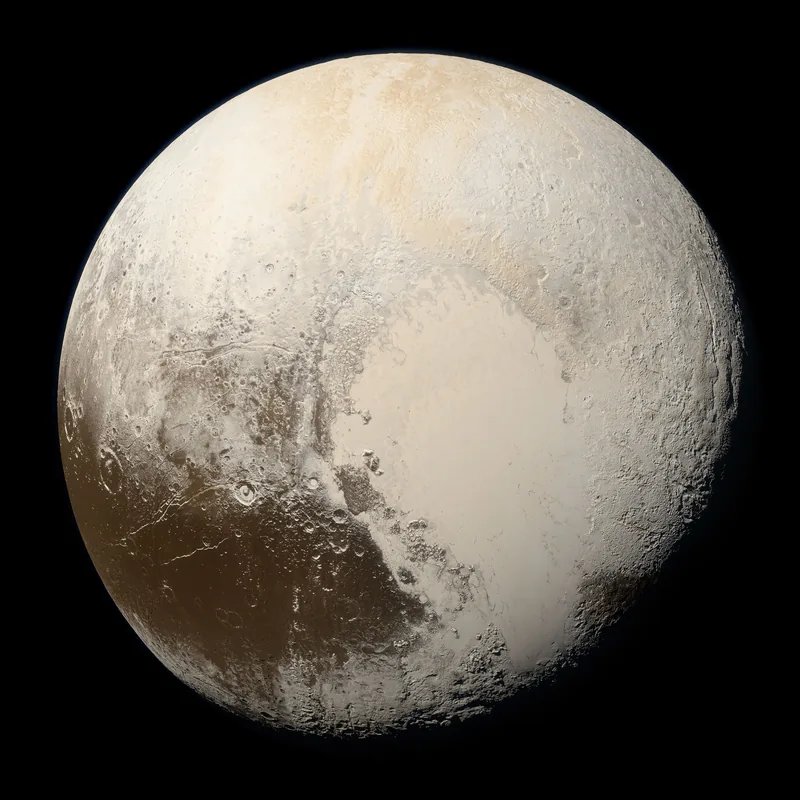
For 76 years it was widely spoken of as the ninth planet. Then, on 24 August 2006 in Prague, the IAU voted. Resolution 5A defined planet and dwarf planet as distinct classes; Resolution 6A recognised Pluto as a dwarf planet and as the prototype of a new category of trans-Neptunian objects. Resolution 5B, which would have added the word “classical” to the eight planets, did not pass. Resolution 6B, which would have named the new category “plutonian objects,” was defeated 183 to 186. [source] The category later came to be discussed as plutoids; this site quotes the 2006 resolutions that actually passed, and does not tidy the vote.
Charon was found in June 1978 by James Christy and Robert Harrington at the U.S. Naval Observatory in Flagstaff, Arizona — about six miles from where Pluto itself had been discovered at Lowell Observatory. They were not even looking for moons, the official Charon page says; they were trying to refine Pluto’s orbit around the Sun. The name honours the mythological boatman and, the facts page notes, Charlene, Christy’s wife, who was nicknamed Char. [source] [source]
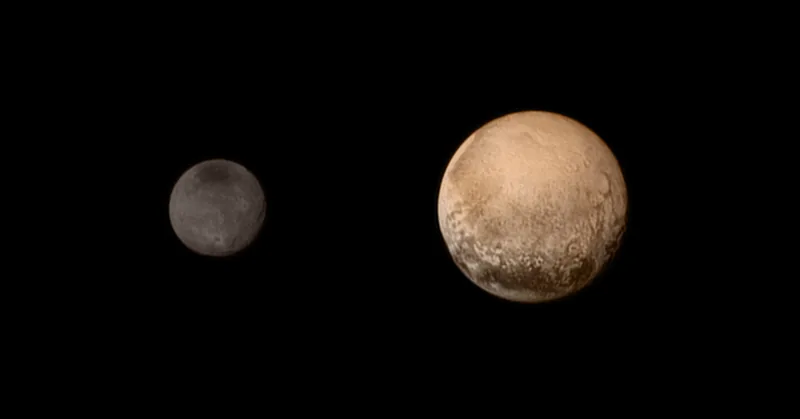
From 1979 to 1999, NASA Science says, Pluto was near perihelion and was actually closer to the Sun than Neptune. [source] New Horizons launched later, and on 14 July 2015 gave humankind the first close-up looks at this dwarf planet and its moons. [source]
Enjoyed a clearly labelled dwarf planet, and a heart of nitrogen ice?
No pop-ups. No intrusive advertising. Just interesting stuff. A little support helps the next planets.im site get built.