A dwarf planet
Why Pluto is a dwarf planet — in the IAU’s own words, and in NASA’s.
Planets and dwarf planets are two distinct classes of objects, the IAU said on 24 August 2006. Pluto is a dwarf planet by that definition. The official sizes and distances then come in more than one official wording, and they all stay visible.
The important word on this site is not a slight. It is a category.
A desk of official definitions and official sizes
The IAU, announcing the result of the 24 August 2006 vote in Prague, agreed that a planet is a celestial body that (a) is in orbit around the Sun, (b) has sufficient mass for its self-gravity to overcome rigid body forces so that it assumes a hydrostatic equilibrium (nearly round) shape, and (c) has cleared the neighbourhood around its orbit. A dwarf planet meets (a) and (b), has not cleared the neighbourhood around its orbit, and is not a satellite. “It was agreed that ‘planets’ and ‘dwarf planets’ are two distinct classes of objects.” The first members of the dwarf-planet category named that day were Ceres, Pluto and 2003 UB313. Resolution 6A adds: Pluto is a dwarf planet by that definition, and the prototype of a new category of trans-Neptunian objects. [source]
NASA Science paraphrases the same decision, and should be read as a paraphrase, not as a substitute for the resolution text: “a dwarf planet is an object in orbit around the Sun that is large enough to pull itself into a nearly round shape but has not been able to clear its orbit of debris.” The IAU, the same facts page says, placed Pluto in that category because it is in the Trans-Neptunian region, where other objects might cross its orbital path. [source]
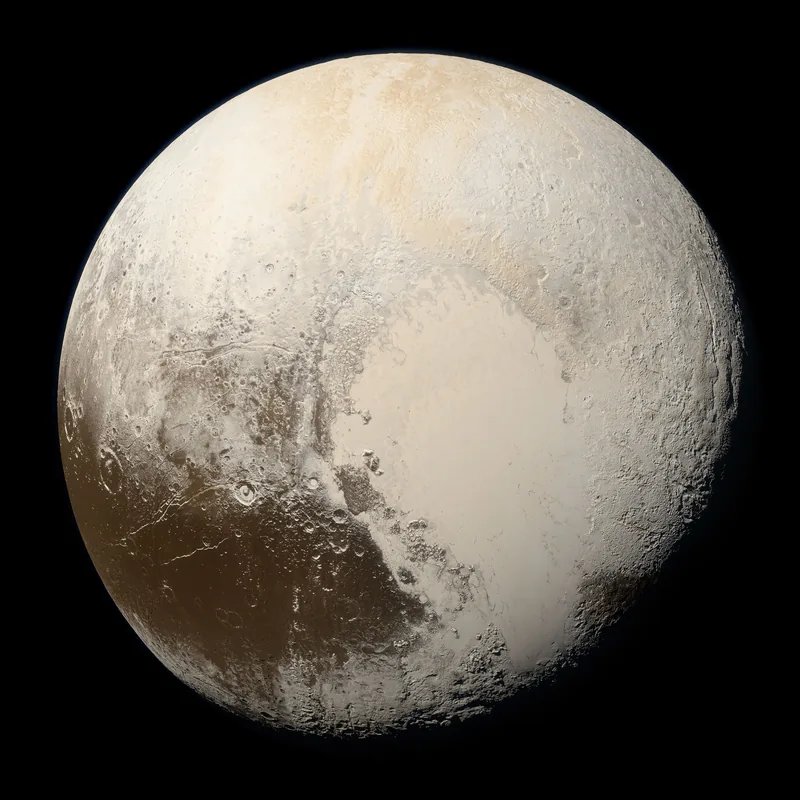
Three official widths, not one
The official fact sheet gives Pluto an equatorial, polar and volumetric mean radius of 1,188 km, a ratio of 0.186 against Earth. [source] NASA Science’s facts page says, in its introduction, that Pluto is only about 1,400 miles wide, “about half the width of the United States,” and later, in the size section, that it has an equatorial diameter of about 1,477 miles (2,377 kilometres), about one-fifth the width of Earth, and — later still — that Pluto is about two-thirds the diameter of Earth’s Moon. [source] Those official wordings are close, and they are not the same sentence. This desk does not pick one and hide the others.
The same kind of care applies to distance. The fact sheet’s semimajor axis is 5,869.656 × 106 km, or 39.48168677 AU. [source] NASA Science’s introduction says Pluto is about 3.6 billion miles from the Sun; the size section says an average distance of about 3.7 billion miles (5.9 billion kilometres), or 39 AU, and that sunlight takes 5.5 hours to travel that far. [source] The orbit is both elliptical and tilted: NASA Science gives a 248-year-long path that can take Pluto as far as 49.3 AU and as close as 30 AU. [source] The fact sheet’s year is 90,560 days, a ratio of 247.94, with perihelion 4,434.987 × 106 km and aphelion 7,304.326 × 106 km. [source]
Enjoyed a clearly labelled dwarf planet, and a heart of nitrogen ice?
No pop-ups. No intrusive advertising. Just interesting stuff. A little support helps the next planets.im site get built.