Explore planets.im

For families

Pluto, told a little more slowly — and still called a dwarf planet.

The same official pages, with the word dwarf planet used clearly, and the surprising bits left surprising.

A shorter walk, still from official pages, and still clear about the word dwarf planet.

A dwarf planet is a kind of world, not a telling-off

In 2006, astronomers agreed that the word planet would mean one official class of object, and that dwarf planet would mean another. Pluto belongs to the second class, and is the example they pointed to. [source] It is still a real world, with mountains, ice, an atmosphere and moons. The dwarf-planet desk puts the official wording in one room.
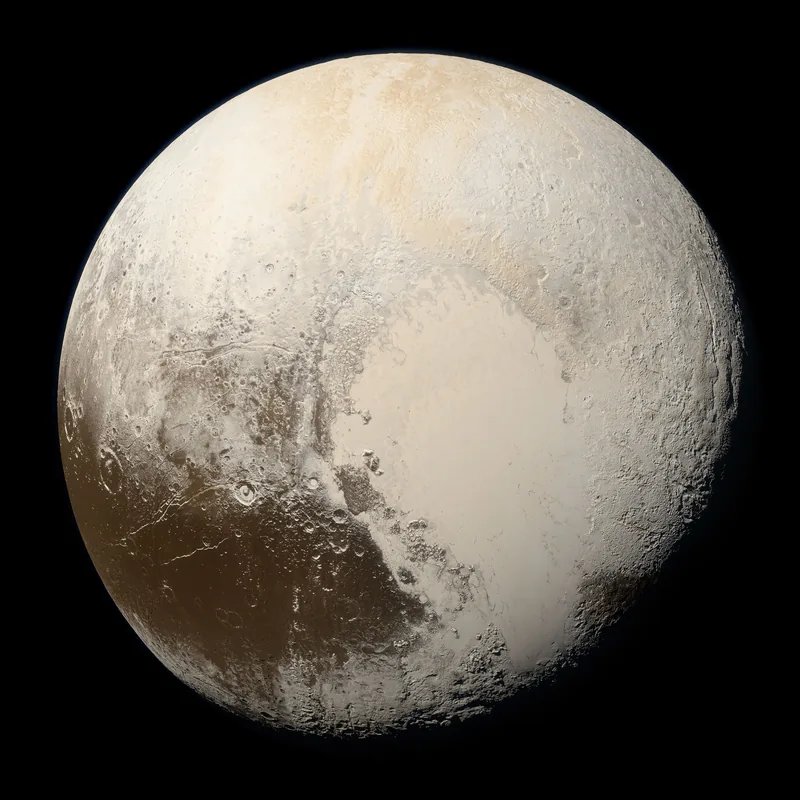
A true-colour New Horizons portrait of Pluto, with the bright heart-shaped region of Sputnik Planitia
Pluto, taken by New Horizons on 14 July 2015, from 22,025 miles (35,445 kilometres). The official file says the striking features are clearly visible, including the bright expanse of Pluto’s icy, nitrogen-and-methane rich “heart,” Sputnik Planitia, and that the natural-looking colours result from refined calibration of data gathered by the colour Multispectral Visible Imaging Camera (MVIC). True colour, as labelled. Public domain. Photo: NASA / Johns Hopkins University Applied Physics Laboratory / Southwest Research Institute · Public domain · NASA/JHUAPL/SwRI / Wikimedia Commons

A heart of ice, named over breakfast

An 11-year-old in Oxford, Venetia Burney, suggested the name Pluto over breakfast in 1930. [source] Seventy-five years later, a spacecraft photographed a bright heart on its face, made of frozen nitrogen, with water-ice mountains beside it.

A close New Horizons view of Pluto’s icy mountains rising beside a smooth, craterless plain
The Icy Mountains of Pluto, an official New Horizons still from the 14 July 2015 encounter, released by JHUAPL. Water-ice mountains stand beside a smooth plain. Public domain. Photo: NASA / JHU APL / SwRI · Public domain · NASA/JHUAPL/SwRI / Wikimedia Commons

A moon that stays put

Charon is so large, compared with Pluto, that the two are often talked about together. Charon does not rise and set. It hangs over the same place in the sky. [source] That is a useful picture to hold onto: two worlds locked in a slow dance, far out in the Kuiper Belt.
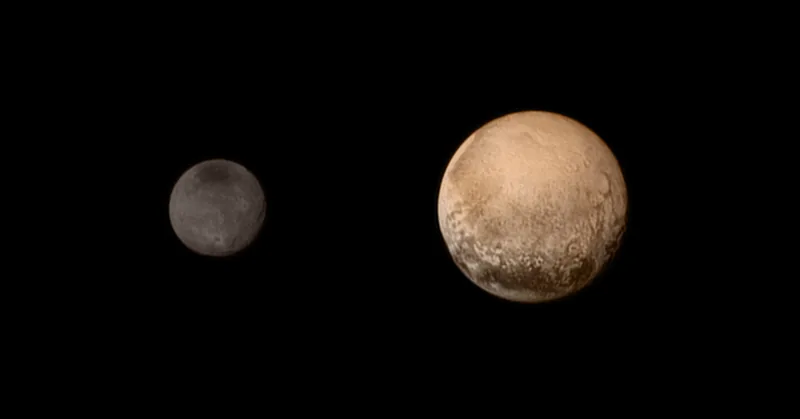
A colour portrait of Pluto and Charon together, taken by New Horizons on 11 July 2015
Pluto and Charon on 11 July 2015, from New Horizons’ final approach. The official caption calls it a portrait showing striking colour and brightness contrast, made from high-resolution black-and-white LORRI images colourised with Ralph data collected from the last rotation of Pluto. Public domain. Photo: NASA / JHUAPL / SwRI · Public domain · NASA/JHUAPL/SwRI / Wikimedia Commons
Keep the lights on

Enjoyed a clearly labelled dwarf planet, and a heart of nitrogen ice?

No pop-ups. No intrusive advertising. Just interesting stuff. A little support helps the next planets.im site get built.