Discoveries
Unusual things official pages say about this dwarf planet.
A world named over breakfast, reclassified in Prague, photographed once at close range, and still able to surprise a paper in 2026.
An 11-year-old named a world
Venetia Burney, 11, offered the name Pluto over breakfast on 14 March 1930. NASA Science quotes Alan Stern: her interest and success “caught the attention of the world and earned her a place in the history of planetary astronomy that lives on.” [source]
A new class of object, in the IAU’s own words
On 24 August 2006 the IAU made planets and dwarf planets two distinct classes, and named Pluto a dwarf planet and the prototype of a new category of trans-Neptunian objects. [source] That is not a footnote on this site. It is the first fact.
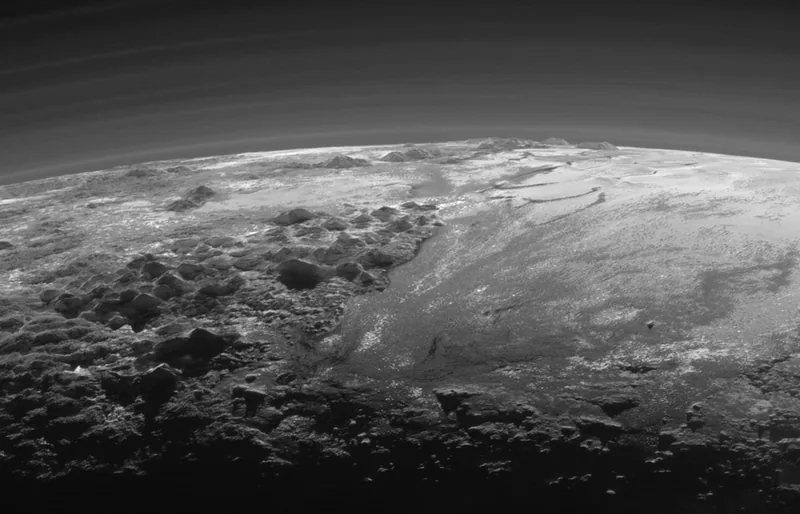
The only close look, so far
New Horizons, on 14 July 2015, was the first and still the only spacecraft to fly by this dwarf planet. It found water-ice mountains 2 to 3 kilometres high, a craterless nitrogen plain, a blue haze, and a moon system in a locked dance. [source]

A heart that may still be leaking liquid
A NASA Science story dated 5 August 2026 reports the first evidence of recently flowing liquid on Pluto: a new analysis of 2015 imagery, published on 31 July in the Planetary Science Journal, suggesting liquid nitrogen is rising through cracks at the northern edge of Sputnik Planitia. Rain, the same official story says, is physically impossible there. [source]
A 20-year spell closer than Neptune
From 1979 to 1999, Pluto was closer to the Sun than Neptune. NASA Science says the two cannot crash, because for every three laps Neptune takes, Pluto makes two. [source]
Enjoyed a clearly labelled dwarf planet, and a heart of nitrogen ice?
No pop-ups. No intrusive advertising. Just interesting stuff. A little support helps the next planets.im site get built.