Explore planets.im

The surface

A heart of nitrogen ice — and mountains of water ice beside it.

New Horizons found a craterless, convecting plain, valley glaciers, and a blue haze. A NASA Science story dated 5 August 2026 then reported the first evidence of recently flowing liquid on Pluto, from a new look at those 2015 pictures.

NASA Science describes a surface of mountains, valleys, plains and craters. The most prominent plains appear to be made of frozen nitrogen gas and show no craters, with structures suggesting convection. The tallest mountains are 6,500 to 9,800 feet (2 to 3 kilometres) high — big blocks of water ice, sometimes coated with frozen gases like methane. Long troughs and valleys run as long as 370 miles (600 kilometres). Craters as large as 162 miles (260 kilometres) across dot some of the landscape, some showing signs of erosion and filling, which suggests tectonic forces are slowly resurfacing Pluto. [source]
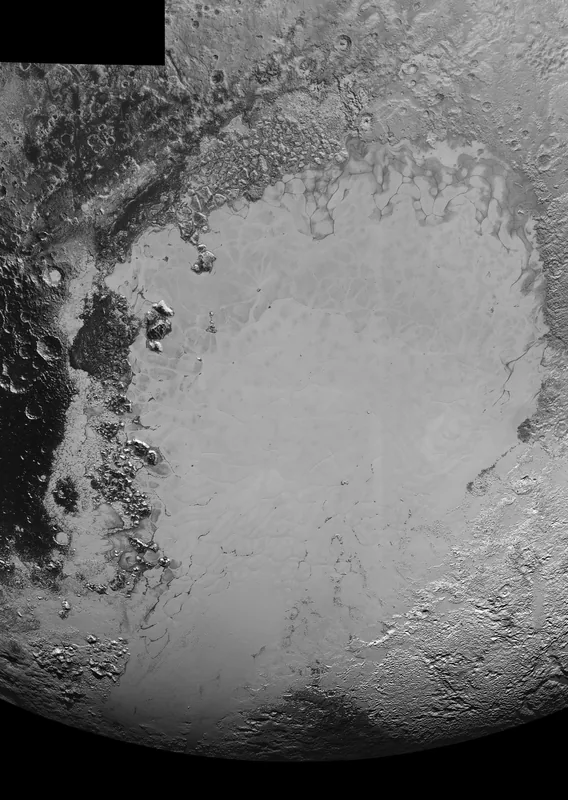
A high-resolution mosaic of the smooth, bright icy plain at the heart of Pluto, informally named Sputnik Planum in 2015
A mosaic of high-resolution LORRI images, returned in early September 2015, dominated by the informally named icy plain Sputnik Planum — the file’s own wording. The region is now officially Sputnik Planitia; the 2015 caption is not silently rewritten. The smallest visible features are 0.5 miles (0.8 kilometres). Public domain. Photo: NASA / Johns Hopkins University Applied Physics Laboratory / Southwest Research Institute · Public domain · NASA/JHUAPL/SwRI / Wikimedia Commons

The mosaic above is dominated by the bright icy plain the 2015 caption informally named Sputnik Planum. The region is now officially Sputnik Planitia. The file’s wording is left in 2015; the later official name is given beside it, not over it.
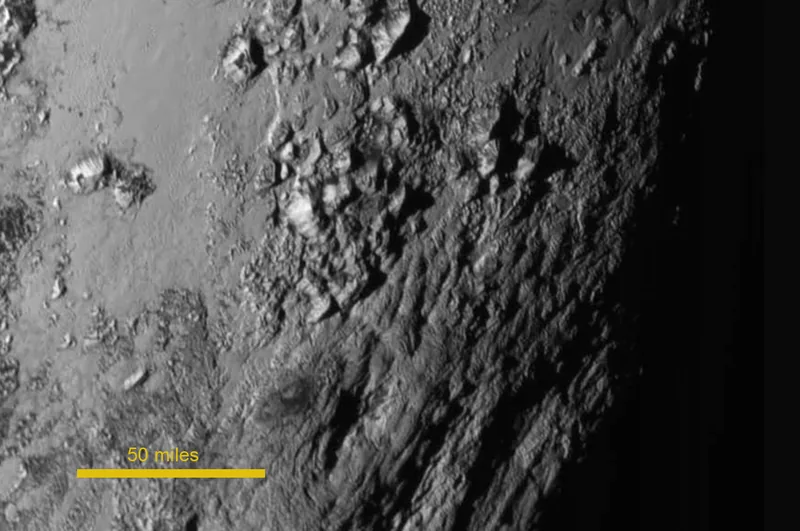
A close New Horizons view of Pluto’s icy mountains rising beside a smooth, craterless plain
The Icy Mountains of Pluto, an official New Horizons still from the 14 July 2015 encounter, released by JHUAPL. Water-ice mountains stand beside a smooth plain. Public domain. Photo: NASA / JHU APL / SwRI · Public domain · NASA/JHUAPL/SwRI / Wikimedia Commons
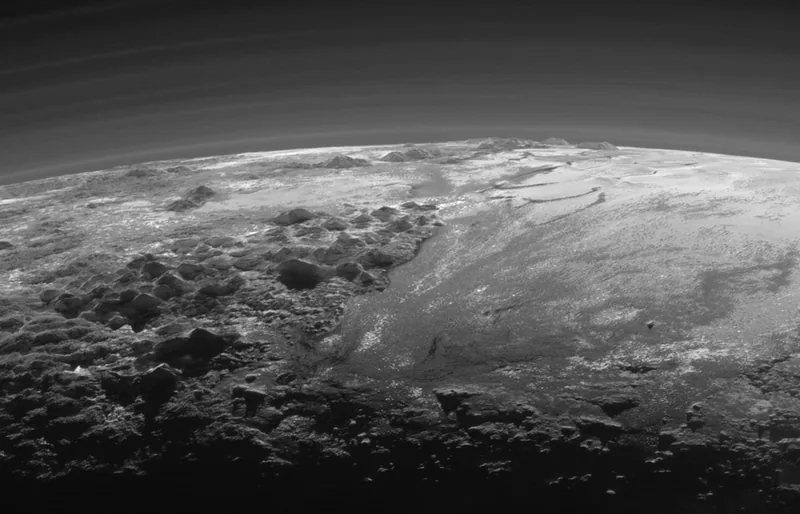
A backlit New Horizons view of icy mountains and frozen plains on Pluto, 15 minutes after closest approach
PIA19947, “Closer Look: Majestic Mountains and Frozen Plains.” Just 15 minutes after closest approach on 14 July 2015, New Horizons looked back toward the Sun and captured this backlit view of Norgay and Hillary Montes and the frozen plains. Public domain. Photo: NASA / Johns Hopkins University Applied Physics Laboratory / Southwest Research Institute · Public domain · NASA/JHUAPL/SwRI / Wikimedia Commons

Fifteen minutes after closest approach on 14 July 2015, New Horizons looked back toward the Sun and caught those icy mountains in backlight. NASA Science, on temperatures, offers more than one official wording: on average, −387°F (−232°C); and, on the surface section, as cold as −375 to −400°F (−226 to −240°C). [source] The fact sheet lists a surface temperature of 24–38 K (−247 to −233°C) and a surface pressure of about 13 microbar, in an atmosphere that is 99% nitrogen, with 0.5% methane and 0.05% carbon monoxide. [source]
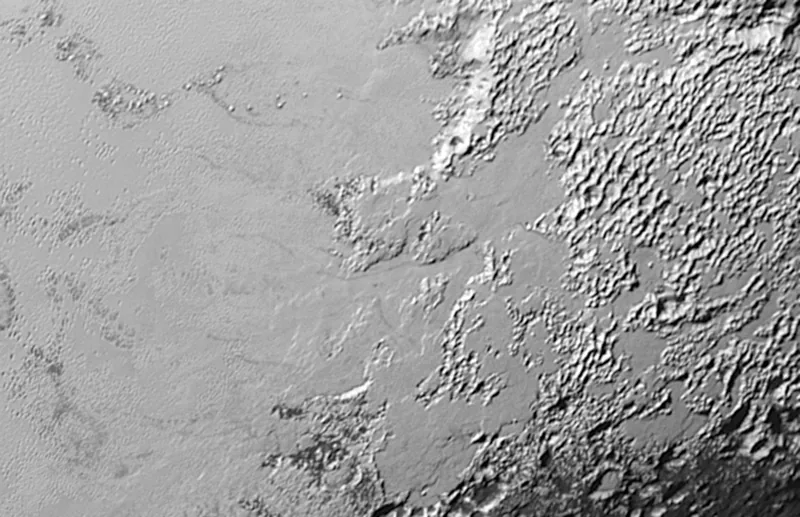
Valley glaciers of probable frozen nitrogen draining from Pluto’s mountains onto a bright icy plain
PIA19944, “Valley Glaciers on Pluto.” The official caption says ice (probably frozen nitrogen) that appears to have accumulated on the uplands is draining from Pluto’s mountains onto the informally named Sputnik Planum through valleys 2 to 5 miles (3 to 8 kilometres) wide, in a view 390 miles (630 kilometres) across. Informal 2015 name kept as the file has it. Public domain. Photo: NASA / Johns Hopkins University Applied Physics Laboratory / Southwest Research Institute · Public domain · NASA/JHUAPL/SwRI / Wikimedia Commons

The atmosphere, NASA Science says, expands when Pluto comes closer to the Sun and collapses as it moves farther away — similar to a comet. When Pluto is close to the Sun, surface ices sublimate and rise to form a thin atmosphere; when it is far away, the bulk of that atmosphere may freeze and fall as snow. [source]


Pluto as a receding crescent, with blue haze rays, in New Horizons’ high-resolution farewell colour view
PIA21590, “Blue Rays, New Horizons’ High-Res Farewell to Pluto.” The official caption calls this the highest-resolution colour departure shot of Pluto’s receding crescent, taken when the spacecraft was 120,000 miles (200,000 kilometres) away, shown in approximate true color, from a mosaic of six LORRI frames with colour added from lower-resolution Ralph data. Published 24 March 2017; taken 14 July 2015. Public domain. Photo: NASA / Johns Hopkins University Applied Physics Laboratory / Southwest Research Institute · Public domain · NASA/JHUAPL/SwRI / Wikimedia Commons
A New Horizons view of Pluto’s haze layer, showing a blue sky around the dwarf planet’s limb
“Pluto’s Blue Sky”: the official caption says Pluto’s haze layer shows its blue colour in this picture from New Horizons’ Ralph/MVIC, and that the high-altitude haze is thought to be similar in nature to that seen at Saturn’s moon Titan, likely involving sunlight-initiated chemical reactions of nitrogen and methane. Public domain. Photo: NASA / JHUAPL / SwRI · Public domain · NASA/JHUAPL/SwRI / Wikimedia Commons

A 2026 reading of the 2015 heart

On 5 August 2026, NASA Science reported a new analysis of New Horizons imagery from the 2015 encounter. The story says the analysis “provides evidence that liquid nitrogen is rising to Pluto’s surface through cracks in the northern edge of the Sputnik Planitia,” and calls this “the first evidence of recently flowing liquid on Pluto.” The research was published on 31 July in the Planetary Science Journal. Alan Stern, the mission’s principal investigator and lead study author, is quoted: “Pluto never stops surprising us.” The same official story says liquid-nitrogen rain is physically impossible under Pluto’s conditions, and that the liquid is thought to be flowing up from underneath the glacier. [source] That is a dated 2026 analysis of 2015 pictures, presented here as NASA Science presented it, not as a second fact sheet.

Keep the lights on

Enjoyed a clearly labelled dwarf planet, and a heart of nitrogen ice?

No pop-ups. No intrusive advertising. Just interesting stuff. A little support helps the next planets.im site get built.