Myths versus facts
A few things this dwarf planet is not.
A new official class is not an insult. A heart of ice is not a decoration. And “about 1,400 miles” is not the only official width.
Myth: calling Pluto a dwarf planet is a slight, or a demotion in the everyday sense
The IAU was explicit: planets and dwarf planets are two distinct classes of objects. Resolution 6A recognises Pluto as a dwarf planet and as the prototype of a new category of trans-Neptunian objects. [source] NASA Science describes a complex world of mountains, glaciers, an atmosphere and five moons, explored at close range by New Horizons. [source] A new class is not the same thing as an insult, and this site does not treat it as one.
Myth: Pluto is still, officially, the ninth planet
The IAU’s 2006 definition lists eight planets: Mercury, Venus, Earth, Mars, Jupiter, Saturn, Uranus and Neptune. Pluto is a dwarf planet by that definition. [source] NASA Science’s facts page is titled under dwarf planets, and asks, at the top, why Pluto is no longer a planet. [source]
Myth: Pluto is always farther from the Sun than Neptune
From 1979 to 1999, NASA Science says, Pluto was actually closer to the Sun than Neptune. The two cannot crash, because of a 3:2 repeating pattern. [source]
Myth: a dwarf planet this cold can have no atmosphere, and no interesting geology
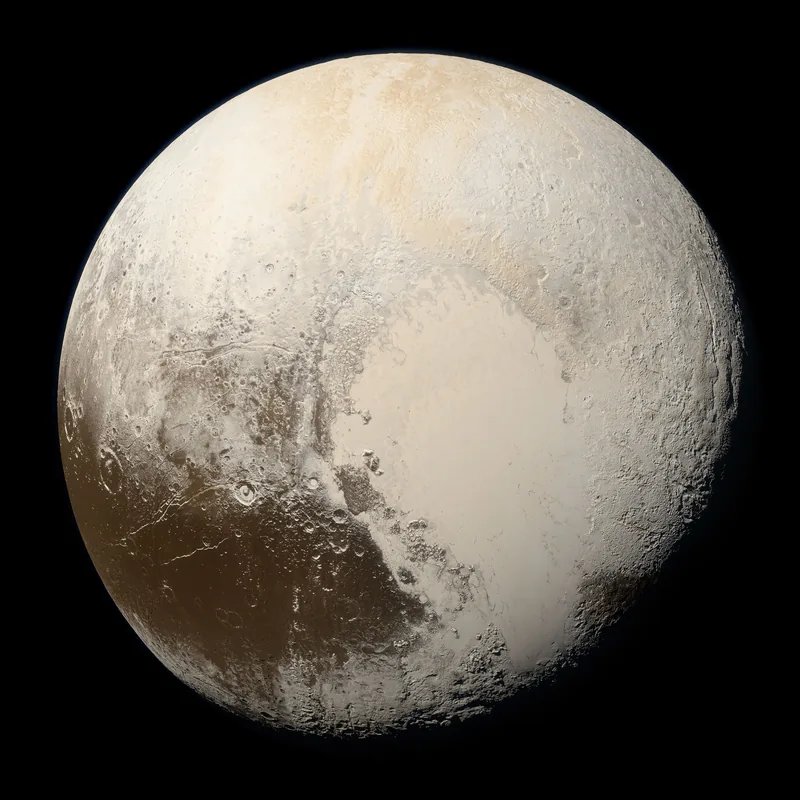
NASA Science describes a thin nitrogen atmosphere that can expand and later fall as snow, water-ice mountains 2 to 3 kilometres high, a craterless convecting nitrogen plain, and valley glaciers. [source] A 5 August 2026 NASA Science story then reported the first evidence of recently flowing liquid on Pluto, from a new analysis of the 2015 pictures. [source]
Myth: there is one official width, and one official distance
The fact sheet’s 1,188 km radius, Science’s “about 1,400 miles,” and Science’s “about 1,477 miles (2,377 kilometres)” are all official wordings. So are 3.6 billion miles and 3.7 billion miles, on different parts of the same facts page. This site keeps them unblended.
Myth: Charon is a minor companion
NASA Science calls it about half Pluto’s size, the largest satellite relative to the body it orbits, hovering over one spot, and — on one official page — part of a “double planet,” on another a “double dwarf planet system.” [source] [source]
Enjoyed a clearly labelled dwarf planet, and a heart of nitrogen ice?
No pop-ups. No intrusive advertising. Just interesting stuff. A little support helps the next planets.im site get built.