Official figures
A fact sheet, a facts page, and the IAU, side by side.
Pluto is a dwarf planet on all three. The sizes, distances and temperatures then come in more than one official wording.
Tabulated figures are from the NASA / NSSDCA Pluto Fact Sheet. [source] Public wording is from NASA Science’s Pluto facts page, the official Charon page, and the IAU’s 24 August 2006 announcement. [source] [source] [source] Where they differ, both — or all three — are kept.
- Classification
- IAU, 24 August 2006, Resolution 6A: Pluto is a dwarf planet by the definition in Resolution 5A, and the prototype of a new category of trans-Neptunian objects. Planets and dwarf planets are two distinct classes. NASA Science: reclassified as a dwarf planet in 2006 because other objects might cross its orbit.
- Discovery and name
- Fact sheet: Clyde Tombaugh, 18 February 1930. NASA Science: named by Venetia Burney, 11, of Oxford, who suggested the Roman god of the underworld to her grandfather on 14 March 1930.
- Size
- Fact sheet: equatorial, polar and volumetric mean radius 1,188 km, ratio 0.186 against Earth; mass 0.01303 × 1024 kg, ratio 0.0022; density 1,854 kg/m3. NASA Science introduction: only about 1,400 miles wide. Size section: equatorial diameter about 1,477 miles (2,377 kilometres), about one-fifth the width of Earth; later, about two-thirds the diameter of Earth’s Moon. Charon page: Pluto is about 1,400 miles wide.
- Distance and light time
- Fact sheet: semimajor axis 5,869.656 × 106 km, or 39.48168677 AU; perihelion 4,434.987 × 106 km; aphelion 7,304.326 × 106 km; year 90,560 days, ratio 247.94. NASA Science introduction: about 3.6 billion miles from the Sun. Size section: average about 3.7 billion miles (5.9 billion kilometres), or 39 AU; sunlight takes 5.5 hours. Orbit section: a 248-year-long path, as far as 49.3 AU, as close as 30 AU.
- Day and tilt
- Fact sheet: sidereal rotation −153.2928 hours (the minus sign marks a retrograde spin); length of day 153.2820 hours; obliquity to orbit 119.51°; inclination of equator 57.47°. NASA Science: one day takes about 153 hours; the axis is tilted 57 degrees, so it spins almost on its side, and the rotation is retrograde, east to west, like Venus and Uranus.
- Sunlight and temperature
- Fact sheet: solar irradiance 0.873 W/m2, ratio 0.00064; surface temperature 24–38 K (−247 to −233°C); surface pressure ~13 microbar. NASA Science: at noon the Sun would be 1/900 the brightness it is on Earth, or about 300 times as bright as the full Moon; average temperature −387°F (−232°C); surface as cold as −375 to −400°F (−226 to −240°C).
- Atmosphere
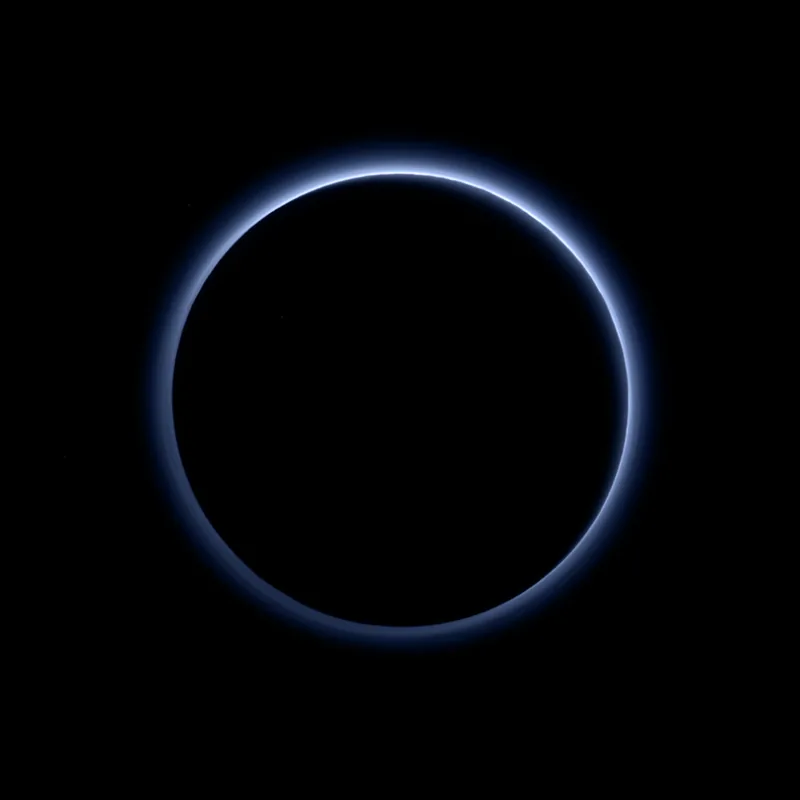
- Fact sheet: 99% nitrogen, 0.5% methane, 0.05% carbon monoxide. NASA Science: a thin atmosphere that expands near the Sun and may freeze and fall as snow when Pluto is far away, similar to a comet.
- Moons
- Both official pages: five — Charon, Nix, Hydra, Kerberos, Styx. Fact sheet: Charon at 19,596 km, period 6.3872 days, radius 606 km. NASA Science facts: 12,200 miles (19,640 kilometres), 153 hours, tidally locked. Charon page: 754 miles (1,214 kilometres) across; 6.4 Earth days; a “double dwarf planet system.” Facts page: often a “double planet.”
- Rings and magnetic field
- NASA Science: no known rings. It is not known whether Pluto has a magnetic field; its small size and slow rotation suggest little or none.
Enjoyed a clearly labelled dwarf planet, and a heart of nitrogen ice?
No pop-ups. No intrusive advertising. Just interesting stuff. A little support helps the next planets.im site get built.